
How to see the aurora in Australia
The aurora australis, or the Southern Lights, is an elusive natural phenomenon. Often described as nature’s fireworks, that comparison is actually scientifically accurate. The aurora is produced through the same physical principle that creates fireworks: excited atoms releasing energy in the form of light. In this blog I will explain:
The science of how the aurora works
Where to see the aurora in Australia
How to see the aurora with your eyes
How to photograph the aurora
A practical packing list for aurora hunting
Why the aurora is colourful
Earth’s atmosphere is made up of gases including oxygen and nitrogen. During periods of increased solar activity, the Sun releases large amounts of energy and charged particles. When this energy reaches Earth, it interacts with our planet’s magnetic field (the magnetic field is a protective shield around the Earth).
This solar energy excites gases in the upper atmosphere. When these gases become excited, they release energy in the form of visible light. Different gases emit different colours, which is why the aurora appears colourful.
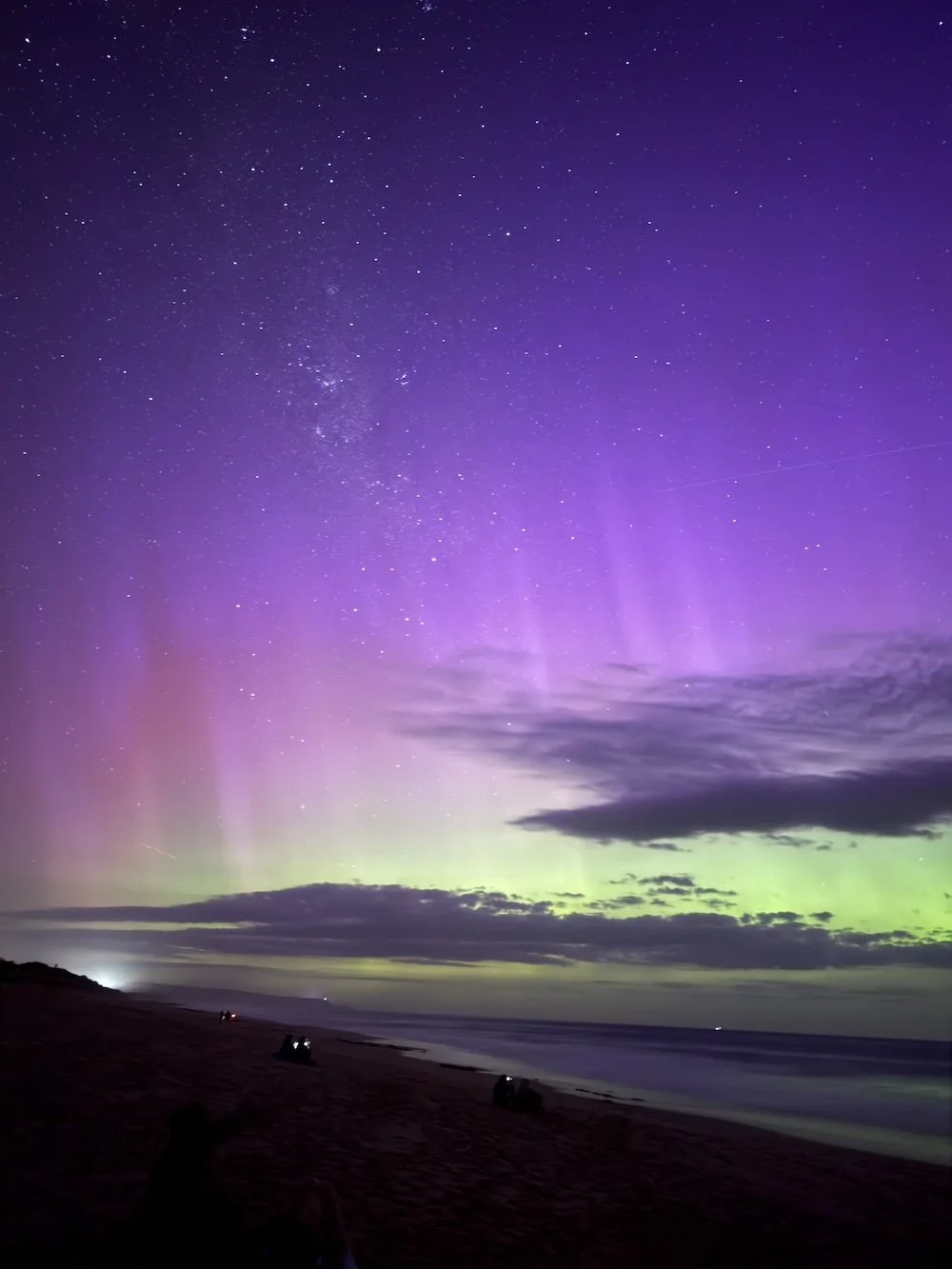
The main gases and their colours are:
Green: oxygen
Pink and purple: nitrogen
This is why green and pink tend to be the most commonly observed colours during an aurora.
But why?
If you are someone who, like me, always asks “but why”, the more in-depth scientific explanation below goes a step further.
The science of an aurora
The Sun is not a constant, quiet star. It moves through cycles of activity and periodically releases large bursts of energy in the form of solar flares and coronal mass ejections. These events send charged particles streaming through space towards Earth.
When this solar energy reaches our planet, it interacts with Earth’s magnetic field. Charged particles are guided along magnetic field lines toward the polar regions, where they collide with atoms and molecules in the upper atmosphere.
These collisions transfer energy to electrons within atmospheric gases. When electrons absorb energy, they enter an excited state. As they return to a lower energy state, they release that excess energy as visible light. This process is what creates the aurora.
Different atmospheric gases produce different colours:
Green light is produced primarily by oxygen at lower altitudes
Red light is produced by oxygen at higher altitudes
Pink, purple and blue tones are produced by nitrogen
The combination of gas type, altitude and energy input determines the colour, intensity and structure of the aurora.
Where to see the aurora australis
There is no single, guaranteed location to see the aurora australis in Australia. Successful viewing depends on a combination of geography, weather and timing.
The key requirements are:
A clear view to the south
Dark skies with minimal light pollution
Clear weather with little to no cloud cover
Ideally, low moonlight
In Victoria, this often means coastal locations with uninterrupted southern horizons, such as open beaches or headlands away from towns. Similar principles apply in Tasmania and southern parts of South Australia.
Location is critical, but flexibility is just as important. Auroras do not appear on a fixed schedule and cannot be reliably predicted to the minute, the hour or even the night.
How to know when to see the aurora
There are no regular or guaranteed times for aurora displays. Forecasting tools provide estimates based on solar and geomagnetic activity, but these remain predictions rather than promises.
If there is a chance of auroral activity on a given night, the only way to maximise your chances is to be outside, facing south, and prepared to wait. It is very common to spend hours waiting and see nothing at all.
Facebook community groups can be a helpful way to learn more and connect with others who are also on the hunt. Please remember to be respectful of others and the environment.
One active group is Aurora Australis, run by Arun Chandran:
https://www.facebook.com/share/g/17Kg6Du8tD/
Arun also runs regular meet-ups, taking participants to suitable locations and photographing them during aurora events. He is an absolute legend!
Apps commonly used by aurora hunters include:
Aurora
Glendale
Aurora Alerts
Space Weather Live
These tools track solar wind speed, geomagnetic indices and real-time space weather conditions, which together help assess the likelihood of an auroral event.
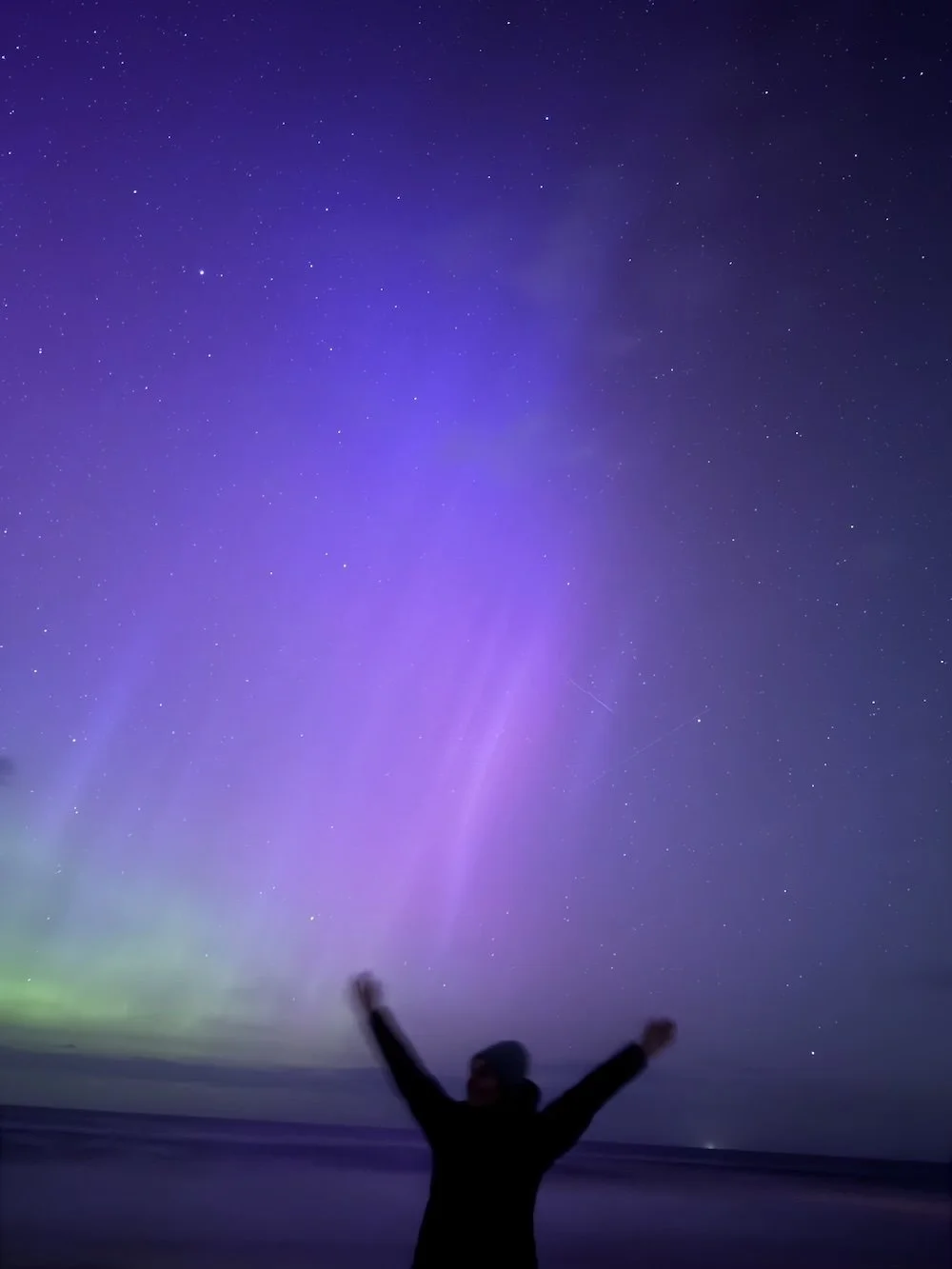
It is important to manage expectations. Many auroras visible in Australia are faint and may not be obvious to the naked eye. Long-exposure photography often reveals colours and structures that are difficult or impossible to see without a camera.
How to photograph the aurora
Photographing the aurora australis typically requires long-exposure techniques.
Key principles include:
Use a tripod to stabilise your camera
Use a wide-angle lens to capture more of the sky, ideally with a low f-stop
Use long exposures to allow light to accumulate on the sensor
Balance ISO and shutter speed to avoid excessive noise
Photographing the aurora with your phone
Phone cameras can also capture auroras when mounted on a tripod and used in night or long-exposure modes. Aim to use the longest shutter speed your phone allows.
How to see the aurora with your eyes
Near the North or South Pole, seeing the aurora with the naked eye is very likely when conditions are right. In these regions, colours and moving beams are often clearly visible.
Further away from the poles, seeing the aurora with the eye becomes much harder. The vivid images captured by cameras are not always what the aurora looks like in real time. Auroras can be faint, and photographs often show more colour and structure than the human eye can perceive.
In most of Australia, auroras are faint because we sit far from the magnetic poles, where charged solar particles are less concentrated. In low light, the human eye relies on rod cells, which detect brightness but not colour, so auroras often appear as white or pale beams. Cameras use long exposures and higher light sensitivity, allowing them to record the colour our eyes cannot see in real time.
Safety and environmental considerations
Aurora hunting often involves late nights, remote locations and cold conditions. Safety and respect should always be prioritised.
Key considerations include:
Watching for wildlife while driving at night, particularly kangaroos
Dressing appropriately for cold and changing weather
Avoiding cliff edges and unstable coastal terrain in low light
Respecting other people by not shining torches into faces or across photography setups
Taking all rubbish with you and minimising disturbance to natural areas
Practical packing list for aurora hunting
A well-prepared kit makes long, cold nights more comfortable and safer. This list is not comprehensive, but it is a good starting point.
Camera and tech
Camera and phone
Camera tripod
Phone tripod
Charging cords
Portable charging pack
Car charging cables
Personal locator beacon for safety
Clothing
Track pants
Thermal leggings
Thermal top
Jumper
Puffer jacket
Rain jacket
Thick socks
Gloves
Beanie
Hand warmers
Comfort
Pillow
Blanket
Camp chair
Picnic rug
Food and drink
Hot chocolate in a thermos
Snacks
Water
Happy hunting :)